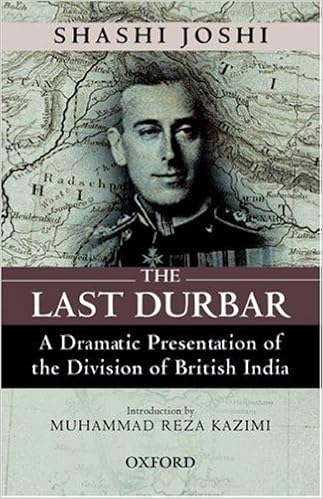
 Numerous histories have been written about the tumultuous developments leading to the Independence and partition of India. They were prosaic description of events in a chronological order. Interestingly Oxford Pakistan has brought out a dramatic presentation of the division of British India by a Delhi-based historian Shashi Joshi. Pakistani scholar Muhammad Reza Kazimi begins his preface: "Much history writing has emerged from the Partition of the Indian subcontinent. And yet the whys and wherefores of the decisions taken during the run-up from March 1947 by the leaders involved continue to remain unclear and intriguing." And he ends: Nevertheless the drama retains its interest mainly because of the impartiality of the author. She doesn't hesitate to depict Sardar Patel as a communalist, and more remarkably, she gives the correct sequence and interpretation of the Kashmir and Junagarh crisis. She has reached out enough.
It portrays the top leadership of Congress-- Gandhi, Nehru, Patel, Krishna Menon, Ambedkar and Rajendra Prasad as a pawn on the chess board of history. Gandhi tried his level best to avoid the partition. He even suggested that let Jinnah be the prime minister but nothing worked. Finally, he put is life on the altar of communalism on the issue of Rs 55 crore aid to Pakistan and laid down his life to the bullets of Nathuram Godse.
This book doesn't answer why the partition couldn't be avoided and why the holocaust be not avoided. A straight narration of history writing can't describe the multiplicity of fast changing scenario. In this book Mountbatten has been shown as a friend of India and he tried to avoid the division despite the popular perception that the British wanted it. The manner in which the leaders turn into actors and appear on the stage of history, is a fascinating way to showcase how dramatic the situation was. No leader was in control. not even Nehru. Jinnah has been portrayed as the villain de piece. He was determined to create a Muslim nation and in his wily ways, he got what he wanted. Nobody could stop.
Pakistan was destined to a failed state because of its fallacious premise. India still has around 18% Muslim population and a large number of Hindus still exist in Pakistan, especially in Sind. Despite the creation of Pakistan, the relations between two neighbours are far from normal. It is a travesty of history that division of a country is no solution.
Except, Mountbatten, no British officer was disturbed that such a bog tragedy was being played across the border. They had no love lost for India. They were in a tearing hurry to leave India. Winston Churchill had even predicted that these natives won't be able to handle India. We did but after paying a heavy price. The wounds are still not fully healed. There is a colony in Lajpat Nagar, Delhi where the widows of partition and their children are still in the shadow of lingering memories of the partition. I met a middle-aged aunt of a friend of mine who had visited them from Pakistan after many decades. Her fleeing family in 1947 had left her behind in a hurry. She had married her Muslim landlord after converting to Islam. There are many such stories in this part of Punjab.
Historians haven't been able to figure out why the Indians were in such a great hurry and why the British couldn't have overseen the transfer of population in a phased manner. But even history doesn't have all the answers.

No comments:
Post a Comment